
Click to Listen
After spending close to six torturous hours on the cross, Jesus “cried with a loud voice” to His Father, “It is finished” and “Father, into thy hands I commend my spirit” (see Mark 15:37, Luke 23:46, John 19:30). He then “bowed his head,” “gave up the ghost” and died (ibid, see Matt 27:50, Mark 15:37, Luke 23:46, John 19:30). Upon His death, Matthew and Mark both testified that “the veil of the temple was rent in twain from the top to the bottom” (see Matt 27:51, Mark 15:38). Also, “the earth did quake, and the rocks rent” (see Matt 27:51).
At the same time, in a distant part of the world, nearly six thousand miles away (approximately 10,000 km), “a great and terrible tempest,” “terrible thunder,” “exceedingly sharp lightnings,” and “exceedingly great quaking of the whole earth” caused “great and terrible destruction in the land” (see 3 Ne 8:6-7, 11-12). For three days, a “thick [vapor of] darkness fell “upon all the face of the land” (see v. 20).
Because of the depth of the darkness, the people who survived the destruction did not see “any light…, neither fire, nor glimmer, neither the sun, nor the moon, nor the stars” (see v. 22). In that state of darkness and destruction, their despair settled in. “[T]here was great mourning and howling and weeping among all the people continually” (see v. 23).
In their weeping, mourning, and lamentations, they cried out “O that we had repented before this great and terrible day” (see vs. 24-25). They then heard a voice from heaven tell them that the destruction they survived was due to the “wickedness and abominations” of those who died (see 3 Ne 9:2-12).
Then lovingly and gently, “Jesus Christ the Son of God,” who was speaking to them, invited them, “will ye not now return unto me, and repent of your sins, and be converted, that I may heal you?” (see vs. 13, 15). He then promised them—
[I]f ye will come unto me ye shall have eternal life. Behold, mine arm of mercy is extended towards you, and whosoever will come, him will I receive; and blessed are those who come unto me.
…And ye shall offer for a sacrifice unto me a broken heart and a contrite spirit. And whoso cometh unto me with a broken heart and a contrite spirit, him will I baptize with fire and with the Holy Ghost (see vs. 14, 20).
On the morning of the fourth day, “the darkness dispersed”, “the earth did cease to tremble,” “the rocks did cease to rend,” “the dreadful groanings did cease,” and “all the tumultuous noises did pass away” (see 3 Ne 10:9). Joy, praise, and “thanksgiving unto the Lord Jesus Christ, their Redeemer” replaced the people’s weeping, wailing, mourning, and lamentations (see v. 10).
In a part of that land, a large group gathered around the House of the Lord. There they not only marveled and wondered over what had happened, but they also spoke with one another about Him who earlier spoke to them, even Jesus Christ, and the signs of His death (see 3 Ne 11:1). As they met and shared with one another what they knew and experienced, a voice from heaven that was not loud but rather small “pierce[d] them…to the center, insomuch that there was no part of their frame that it did not cause to quake,…it did pierce them to the very soul, and did cause their hearts to burn” (see v. 3).
Though this small yet powerful voice burned their hearts and quaked their souls, they did not understand it (see v.4). As the voice persisted a third time to talk to them, they opened their ears to hear it and turned their eyes steadfastly toward heaven to understand it (v. 5). They then heard and understood what the Father was saying to them. He said—
Behold my Beloved Son, in whom I am well pleased, in whom I have glorified my name—hear ye him (see v. 7).
As they gazed upward, “they saw a Man” quietly “descending out of heaven,” without pomp and circumstance. When He finally was with them, considering His unassuming appearance, they believed He was “an angel” (see v. 8). In humility and strength, He stretched out His hand toward them and said—
Behold, I am Jesus Christ, whom the prophets testified shall come into the world.
And behold, I am the light and the life of the world; and I have drunk out of that bitter cup which the Father hath given me, and have glorified the Father in taking upon me the sins of the world, in the which I have suffered the will of the Father in all things from the beginning (see v. 10-11).
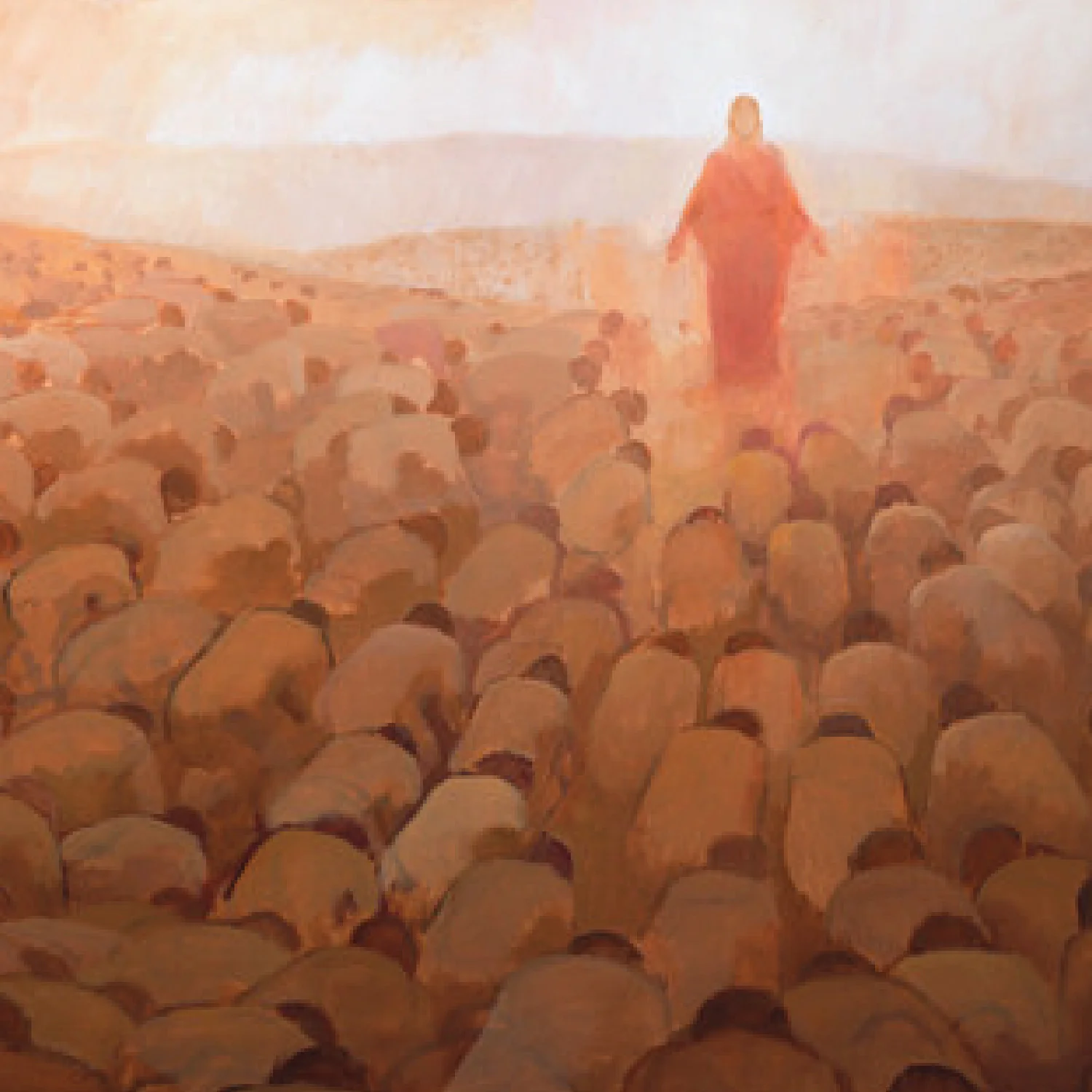
Now knowing that this Man was not an angel, but rather that He was the promised Messiah who all the prophets had testified about from the beginning, stood among them, they “fell to the earth” (v. 12). The Lord then invited them—
Arise and come forth unto me, that ye may thrust your hands into my side, and also that ye may feel the prints of the nails in my hands and in my feet, that ye may know that I am the God of Israel, and the God of the whole earth, and have been slain for the sins of the world (v. 14).
For nearly 10 hours, He then patiently stood and permitted His people, “one by one until they had all gone forth” to “see with their eyes,” “feel with their hands,” and “know of a surety and …bear record, that” He was the prophesied Savior and Redeemer of the world (see. 15).
I find it interesting that He who is the “Lord of lords” and “King of kings” quietly, unassumingly, and humbly came into this world as the Lamb of God who would be sacrificed for the sins of the world (see Rev 17:14, Rev 19:16, John 1:29, 36, 1 Ne 10:10). Instead of being born with wealth and worldly power, He came to parents who had few material goods and who fled to a foreign land for refuge. The prophet Isaiah and later the prophet Abinadi both testified that rather than being born handsome, Jesus had “no form nor comeliness…and when we shall see him, there is no beauty that we should desire him.” (see Isa 53:2, Msh 14:2). Though He promised His disciples mansions that He and His Father would prepare for them, He told them, “[t]he foxes have holes, and the birds of the air have nests; but the Son of man hath not where to lay his head (see Matt 8:20, John 14:2, Enos 1:27, Ether 12:32, 34, 37, D&C 98:18).
Our Savior and Redeemer, who does all things for our benefit because of His love for all of us, invites each of us to “partake of [H]is goodness” and salvation (see 2 Ne. 26:24, 27-28). He invites you and me to follow Him, do the things He has done, and partake of the fruit of the tree of His life and love (see 2 Ne 31:10, 12, Matt 4:19, Matt 9:9).
How do we follow Him? Jesus, our Lord and Savior, was also our servant. When His Apostles were indignant with one another due to perceived pride, the Master taught them in word and deed—
[W]hosoever will be great among you, let him be your minister;
And whosoever will be chief among you, let him be your servant (see Matt 20:26-27).
He then continued by testifying to them that He “came not to be ministered unto, but to minister, and to give his life a ransom for many” (see v. 28). Everything that He said and did as a mortal and a resurrected Man is based on what His Father, our Father in Heaven, asked Him to say or do. He taught His Apostles and us today—
…I do nothing of myself; but as my Father hath taught me, I speak these things.
And he that sent me is with me: the Father hath not left me alone; for I do always those things that please him (John 8:28-29).
How can we know, like Him, what our Heavenly Father wants us to say or do? After washing His Apostles’ feet as a servant, in their final moments together, He reiterated to them four times the need to pray to the Father in His name with a promise that He and the Father will hear and answer them. He said—
And whatsoever ye shall ask in my name, that will I do, that the Father may be glorified in the Son (John 14:13).
If ye shall ask any thing in my name, I will do it (John 14:14).
If ye abide in me, and my words abide in you, ye shall ask what ye will, and it shall be done unto you (John 15:7).
[W]hatsoever ye shall ask of the Father in my name, he may give it you (John 15:16).
To His people in the Americas, He gave them a similar commandment with a promise—
[Y]e must always pray unto the Father in my name;
And whatsoever ye shall ask the Father in my name, which is right, believing that ye shall receive, behold it shall be given unto you (see 3 Ne 18:19-20).
Through His prophet Moroni, He promises all of us—
[W]hoso believeth in Christ, doubting nothing, whatsoever he shall ask the Father in the name of Christ it shall be granted him; and this promise is unto all, even unto the ends of the earth (see Morm 9:21).
A 14-year-old Joseph Smith worried about what to do with his sins and with his desire to worship God. He turned to the Bible to know what to do. He found something the Apostle James wrote that moved him. Through James, the Lord told Joseph and tells all of us—
If any of you lack wisdom, let him ask of God, that giveth to all men liberally, and upbraideth not; and it shall be given him (James 1:5).
Joseph later shared what these words meant to him—
I reflected on it again and again, knowing that if any person needed wisdom from God, I did; for how to act I did not know, and unless I could get more wisdom than I then had, I would never know;
…At length I came to the conclusion that I must either remain in darkness and confusion, or else I must do as James directs, that is, ask of God. I at length came to the determination to “ask of God,” concluding that if he gave wisdom to them that lacked wisdom, and would give liberally, and not upbraid, I might venture (Joseph Smith – History 1:12-13).
As he attempted to pray vocally to God to know what to do, the adversary attempted to destroy him. Joseph explained what happened—
Thick darkness gathered around me, and it seemed to me for a time as if I were doomed to sudden destruction.
…at the very moment when I was ready to sink into despair and abandon myself to destruction—not to an imaginary ruin, but to the power of some actual being from the unseen world, who had such marvelous power as I had never before felt in any being—just at this moment of great alarm, I saw a pillar of light exactly over my head, above the brightness of the sun, which descended gradually until it fell upon me.
It no sooner appeared than I found myself delivered from the enemy which held me bound. When the light rested upon me I saw two Personages, whose brightness and glory defy all description, standing above me in the air. One of them spake unto me, calling me by name and said, pointing to the other—This is My Beloved Son. Hear Him! (vs 15-17).
The light and love of the Father and the Son dispersed the darkness and destruction of the devil. Joseph now knew that They lived and that They knew him. This led the Prophet Joseph, time and again, to turn to the Father in the name of His Son to know what to do, where to go, and what to say.
President Ezra Taft Benson once taught us that “God will have a humble people. Either we can choose to be humble or we can be compelled to be humble” (“Beware of Pride,” April 1989 Saturday Morning Session, Ezra Taft Benson). When we are humble enough to know that we need heaven’s help to know what to say and do, we turn to our Heavenly Father in the name of His Beloved Son for that help. Doing so helps us avoid the darkness and destruction that await all of us when we don’t.
Thomas B Marsh was the first President of the Quorum of the Twelve Apostles in this dispensation. The Lord recognized and warned him that he “had many afflictions because of [his] family” (D&C 31:2). He counseled Thomas to—
Pray always, lest you enter into temptation and lose your reward (vs. 11-12).
Be thou humble; and the Lord thy God shall lead thee by the hand, and give thee answer to thy prayers (D&C 112:10).
While he and Elizabeth, his wife, were in Far West, Missouri, she and Lucinda Harris agreed to share the cream and milk from the cows. Though Lucinda fulfilled her responsibility, Elizabeth appears to have kept the cream and given only the milk.
Lucinda, upset about this, turned to Church leaders for help. Thomas and Elizabeth appealed all the way up from the bishop to the First Presidency. In his support for her, Thomas said, “that he would sustain the character of his wife, even if he had to go to hell for it” (George A. Smith, in Journal of Discourses, 3:283–84). Since she refused to repent, Joseph told Thomas that the Church would impose restrictions on his wife’s membership. Angry with the outcome, Thomas walked away with his wife from the Lord, His calling, and His Church.
For nearly 20 years, Thomas and Elizabeth stayed away from the Church. After Elizabeth passed away, while his health suffered, Thomas’ heart softened. In a letter Thomas wrote to Heber C. Kimball in Salt Lake City, he mourned, “The Lord could get along very well without me and He has lost nothing by my falling out of the ranks; But O what have I lost?!” (“The Faith and Fall of Thomas Marsh,” Revelations in Context).
On his way to Utah, Thomas was rebaptized in Nebraska. On September 6, 1857, President Brigham Young permitted Thomas to speak to the Saints while they met in the bowery. He warned them—
…let no one feel too secure; for, before you think of it, your steps will slide. You will not then think nor feel for a moment as you did before you lost the Spirit of Christ; for when men apostatize, they are left to grovel in the dark” (Journal of Discourses, 5:206).
Thomas would later confess to another—
I want to die in the Church. Oh, if I could see Joseph, and talk with him and acknowledge my faults to him, and get his forgiveness…then I would die happy (Wandle Mace Journal, 209. Church History Library, Salt Lake City).
Thomas died in the faith nearly 10 years later.
As Thomas crossed the veil, I imagine that he saw his beloved Elizabeth. After embracing her, I see Joseph approaching and embracing him. As Thomas looked over Joseph’s shoulder, he saw a familiar figure. I then see Thomas weeping, falling and declaring, as the first Thomas, who was also an Apostle, did, “My Lord and my God” (see John 20:28). The Savior then stretched out His merciful hand to lift him up and to encircle him “eternally in the arms of His love” (see 2 Ne 1:15).
In October 2024, President Russell M Nelson testified to us—
My dear brothers and sisters, in a coming day, Jesus Christ will return to the earth as the millennial Messiah. So today I call upon you to rededicate your lives to Jesus Christ. I call upon you to help gather scattered Israel and to prepare the world for the Second Coming of the Lord. I call upon you to talk of Christ, testify of Christ, have faith in Christ, and rejoice in Christ!
Come unto Christ and “offer your whole [soul]” to Him. This is the secret to a life of joy! ” (“The Lord Jesus Christ Will Come Again,” Russell M Nelson, Sunday Afternoon, October 2024 General Conference).
When we follow Jesus, we will love Him, His Father, and God’s children. The despair and darkness we feel and see in the world will be swallowed up by the joy and consolation that His light brings. Through our humility and faith, we will have confidence in Him and before Him. As we wait to one day stand with Him on Mount Zion, with tears in our eyes and gratitude in our hearts, let us joyfully declare today—
Love divine, all loves excelling,
Joy of Heav’n to earth come down;
Fix in us thy humble dwelling;
All thy faithful mercies crown!
Jesus, Thou art all compassion,
Pure unbounded love Thou art;
Visit us with Thy salvation,
Enter every trembling heart.
Finish, then, Thy new creation;
Pure and spotless let us be;
Let us see Thy great salvation
Perfectly restored in Thee;
Changed from glory into glory,
Till in Heav’n we take our place,
Till we cast our crowns before Thee,
Lost in wonder, love, and praise. (“Love Divine, All Loves Excelling,” Charles Wesley)
Art: Every Knee Shall Bow, by J. Kirk Richards